The Spreadsheet That Changes Everything
It usually starts with a spreadsheet. Someone sitting in a two-bedroom apartment in Somerville, or a small colonial in Stamford, or a ranch in Cranston, opens a new tab and starts comparing numbers. What does a house cost in Woodstock? What are the property taxes? What about groceries, utilities, childcare? And as the columns fill in, the picture that emerges is not just slightly better. It is dramatically better.
The cost of living in Connecticut's Quiet Corner is 30% to 40% lower than in the Boston metro area, and 50% to 70% lower in housing specifically. For families, remote workers, and retirees on fixed incomes, these differences are not marginal adjustments. They are the difference between financial stress and financial breathing room.
Here is the real comparison, category by category, with actual numbers.
Housing: Where the Biggest Savings Live
Housing is the largest expense for most households, and it is where the Quiet Corner advantage is most dramatic.
The Purchase Price Gap
| Location | Median Home Price (2026) | What You Get | |---|---|---| | Boston metro | $750,000+ | 2-3 bed condo or small starter home, minimal land | | Fairfield County CT | $600,000+ | 3-bed ranch on a quarter acre | | Providence metro | $425,000+ | 3-bed colonial in a decent neighborhood | | Hartford suburbs | $375,000+ | 3-bed in a suburban development | | Quiet Corner CT (Windham County) | $360,000 | 3-4 bed on 1-3 acres with a garage and yard |
Sources: Zillow, Realtor.com, CT REALTORS Association, Redfin (2026 data)
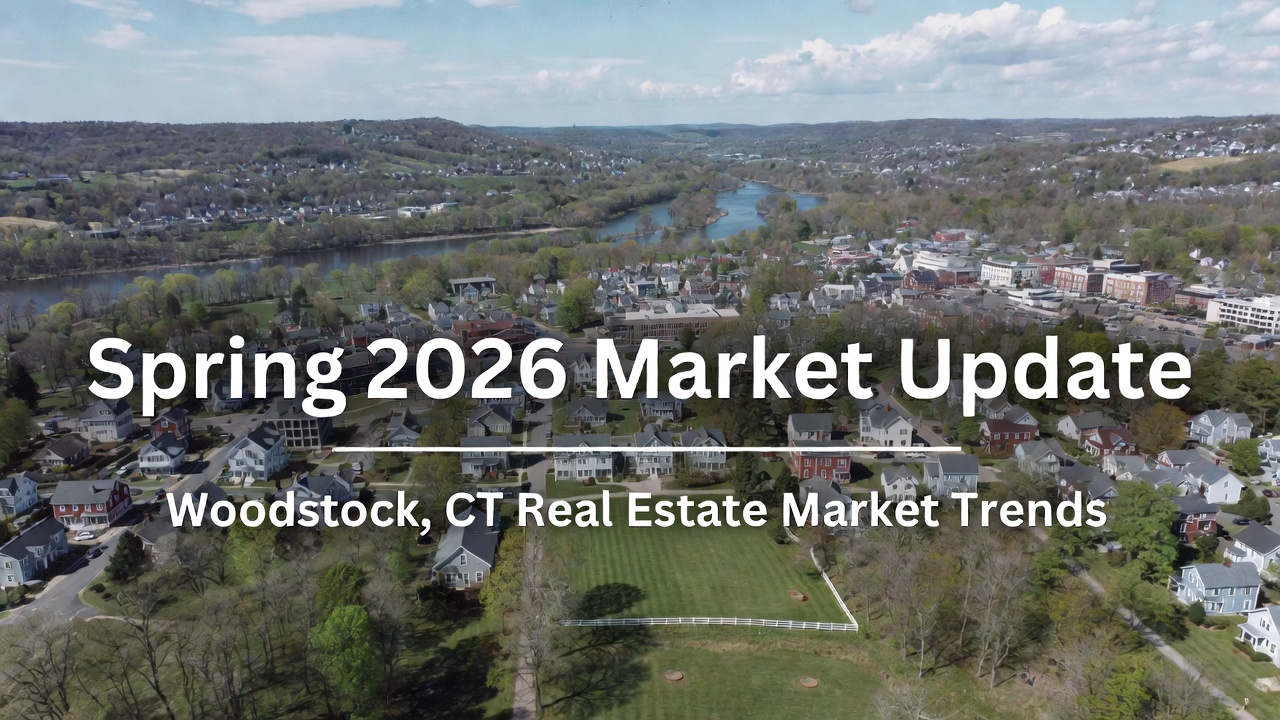
The spring 2026 market update for Woodstock shows the Windham County median sale price at $360,000, up 5.9% year over year. That growth is healthy but not the runaway appreciation that has priced out buyers in metro markets. The result is a region where homeownership is genuinely accessible, even for first-time buyers who have been priced out of the cities.
Monthly Housing Costs
For a $360,000 home in the Quiet Corner versus a $750,000 home in the Boston metro (both with 20% down, 6.5% rate):
| Expense | Quiet Corner | Boston Metro | |---|---|---| | Mortgage (P&I) | $1,820 | $3,790 | | Property taxes | $620 | $800+ | | Insurance | $150 | $200+ | | Total monthly housing | $2,590 | $4,790 | | Annual savings | | $26,400 |
That is over $26,000 per year in housing savings alone, money that can go toward retirement, college funds, travel, or simply living without the constant weight of a mortgage that consumes half your income.
Property Taxes: A Closer Look
Connecticut has a reputation for high property taxes, and at the state level, the reputation is deserved. But taxes vary dramatically by county and town, and Windham County (where Woodstock is located) has some of the most reasonable rates in the state.
The effective tax rate in Woodstock is approximately 2% of market value. On a $360,000 home, that is roughly $7,200 per year, or $600 per month. Compare that to:
- Fairfield County: Effective rates of 1.5% to 2.5%, but on homes that cost $600,000 to $1,000,000+, resulting in tax bills of $9,000 to $25,000+
- Boston suburbs: Tax bills of $6,000 to $12,000 on homes that cost twice as much
- Charlestown RI: Lower effective rate (~1.2% for homestead), but on higher-value homes, resulting in comparable dollar amounts
For a deeper comparison of property taxes in both markets, our property tax guide for Woodstock and Charlestown breaks down the numbers in detail.
Groceries and Everyday Essentials
Grocery costs in the Quiet Corner are roughly comparable to state averages and 5% to 10% lower than in metro areas. The major chains are accessible in Putnam (10 minutes from Woodstock) and Danielson (15 minutes), and prices reflect the lower overhead costs of operating in a less expensive real estate market.
Where the Quiet Corner offers a unique advantage is in the local food economy. Farmers markets, farm stands, and direct-from-farm purchasing are part of daily life here. During the growing season (May through October), locally grown produce, eggs, meat, and dairy are available at prices that are competitive with or lower than supermarket prices, with quality that is incomparably better.
Many homeowners also grow their own food, which is practical when you have one to three acres rather than a postage-stamp suburban lot. A well-maintained vegetable garden can meaningfully reduce your grocery spending while improving the quality of what you eat.
Transportation
This is the one category where the Quiet Corner costs more than urban living, but the premium is smaller than most people expect.
The Trade-Offs
You will drive more. There is no public transit, no Uber, and no walking to the corner store. The nearest grocery store is 10 to 15 minutes away, and trips to Hartford, Providence, or Worcester for shopping, airports, or entertainment are 40 to 60 minutes each way.
However:
- No commuting costs: If you work remotely, you eliminate $200 to $500 per month in gas, tolls, parking, or transit passes
- Lower gas prices: Fuel costs are typically 5% to 15% lower than in metro areas
- Lower insurance rates: Auto insurance premiums are lower in rural areas due to reduced accident rates and lower vehicle density
- No parking costs: You have a driveway, a garage, or both. You never pay for parking
Net effect: For a remote worker, transportation costs in the Quiet Corner are often lower than in the city they left, despite driving more miles. For commuters, the math depends on the frequency and distance of the commute.
Utilities
Electricity
Eversource serves most of northeastern Connecticut, and rates are among the highest in the country (a Connecticut-wide issue, not specific to the Quiet Corner). Monthly electric bills typically run $150 to $250 depending on home size and usage. This is comparable to metro-area costs.
The good news: many Quiet Corner homeowners are adding solar panels, which are highly effective on rural properties with unobstructed south-facing exposure. Connecticut offers net metering, allowing you to sell excess production back to the grid, and federal and state tax credits make the upfront cost increasingly manageable.
Heating
This is a significant line item that does not exist for many metro-area apartment dwellers. Most Quiet Corner homes use oil, propane, or wood for heat, and annual heating costs run $2,000 to $4,000 depending on home size, insulation quality, and fuel prices.
For a detailed breakdown of heating options, including heat pumps, wood stoves, and cost comparisons, our relocation guide covers this topic in depth.
Water and Sewer
There are no water or sewer bills. Your water comes from a private well (no monthly cost) and your wastewater is handled by a septic system (periodic pumping at $300 to $500 every 3 to 5 years). For households that previously paid $50 to $150 per month for municipal water and sewer, this is a meaningful savings.
Healthcare
Healthcare costs in the Quiet Corner are broadly comparable to state averages. Day Kimball Hospital in Putnam (10 minutes from Woodstock) provides emergency, primary care, and many specialty services. Hartford hospitals are 45 minutes away for advanced care.
Where the Quiet Corner offers an advantage is in wait times. Medical practices in smaller communities generally have shorter wait times for appointments, and the patient-to-provider relationship tends to be more personal. Your doctor knows you, your family, and your history in a way that high-volume urban practices often cannot provide.
Childcare and Education
Childcare costs in the Quiet Corner are lower than in metro areas, though the availability of licensed providers is more limited. Home-based childcare providers are common, and rates are typically $200 to $300 per week for full-time care, compared to $400 to $600+ per week in the Boston metro area.
For school-age children, the public schools, including the unique Woodstock Academy, are tuition-free and provide an education that competes favorably with suburban districts. Our guide to school districts in Woodstock and Charlestown covers the details that matter to families.
The Bottom Line: A Side-by-Side Annual Budget
For a family of four with a household income of $150,000:
| Expense | Boston Metro | Quiet Corner CT | Annual Savings | |---|---|---|---| | Housing (mortgage, tax, insurance) | $57,480 | $31,080 | $26,400 | | Transportation | $12,000 | $8,000 | $4,000 | | Groceries | $15,600 | $14,000 | $1,600 | | Utilities (electric, heat, water) | $6,000 | $7,200 | -$1,200 | | Childcare (1 child) | $24,000 | $14,400 | $9,600 | | Healthcare (out of pocket) | $5,000 | $4,500 | $500 | | Total | $120,080 | $79,180 | $40,900 |
The utilities line is higher in the Quiet Corner due to heating costs, but every other category favors the move. The net savings of roughly $40,000 per year is not a rounding error. It is transformative.
What the Numbers Do Not Capture
The cost-of-living analysis shows the financial case, but the lifestyle value is where the comparison becomes lopsided. That $360,000 home in the Quiet Corner comes with land, privacy, clean air, dark skies, a community that knows your name, and a pace of life that most metro-area residents can only experience on vacation.
You cannot put a dollar figure on stepping outside to dead quiet on a Saturday morning, or on your children having space to run and explore, or on knowing your neighbors well enough to borrow a chainsaw or drop off fresh tomatoes. But these things have value, and for the people who have made the move, they are worth more than anything that appears on a spreadsheet.
Curious about what your budget buys in the Quiet Corner? MLD Realty can show you exactly what is available at your price point. Contact us for a personalized market overview.